Material: Finding the Right Golf Ball

Updated: May 4
Why ball fitting matters

When golfers look to improve performance, they usually start with clubs. But one of the most influential pieces of equipment is often ignored: the golf ball.
The truth is, the “best” golf ball isn’t universal. It depends heavily on your swing speed, playing style, and what you need most—distance, control, or feel.
That’s exactly why we built our Excel-based ball fitting tool: to take the guesswork out of choosing the right ball and replace it with a structured, data-driven approach.
What makes Golfballs different?
At a glance, most golfballs look identical. Underneath, they’re engineered very differently. The key factors that influence performance are:
A. Cover Material
The outer layer of the ball plays a huge role in feel and control.
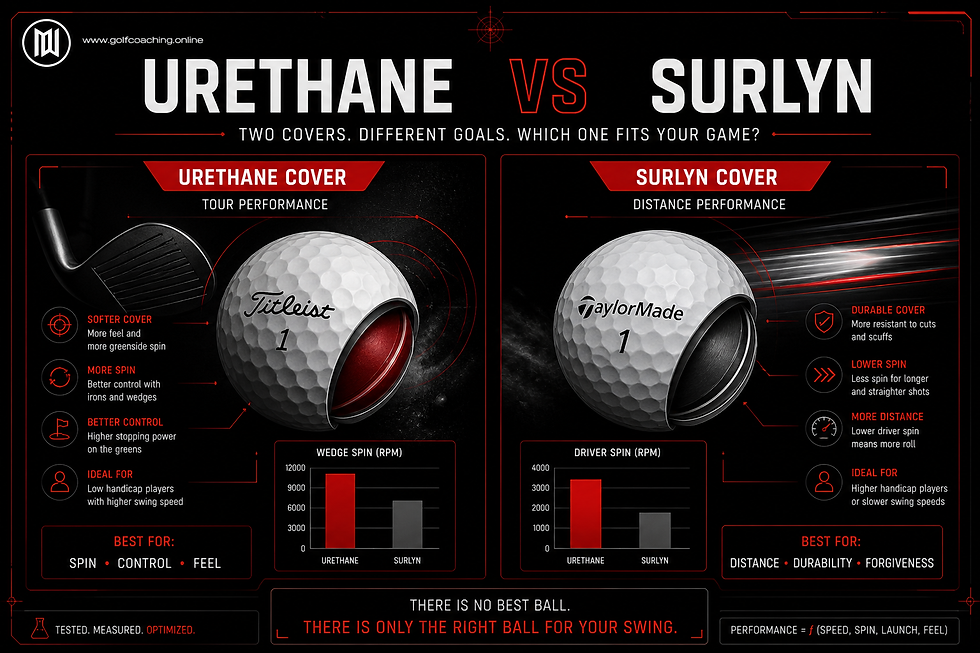
Urethane covers
Softer feel
More spin, especially around the greens
Preferred by better players
Surlyn (ionomer) covers
More durable
Lower spin
Typically longer off the tee
If your priority is short-game control, urethane usually wins. If you want durability and distance, Surlyn can be a better fit.
B. Number of Layers
Modern golf balls can have anywhere from 2 to 5 layers, and each layer serves a purpose.

Fewer layers (2-piece balls)
Lower spin overall
More distance
Simpler construction
Multi-layer balls (3–5 pieces)
Better separation of performance
Low spin off the driver, high spin with wedges
More control for skilled players
More layers don’t automatically mean “better”—they just allow for more fine-tuning depending on your swing.
C. The Spin - Driver vs. Wedges
Spin is one of the most misunderstood aspects of ball fitting.

Driver spin (long game)
Lower spin = more distance and roll
Too much spin = ballooning shots, loss of distance
Wedge spin (short game)
Higher spin = better stopping power
Essential for control around the greens
The challenge is finding a ball that reduces spin off the driver without sacrificing spin with wedges. That balance is where fitting becomes critical.
D. Compression and Feel
Compression is often described as “how soft or firm a ball feels,” but it’s also tied to swing speed.

Lower compression balls
Compress more easily
Better for slower swing speeds
Softer feel
Higher compression balls
Require higher swing speed to optimize
Provide more control and stability
Typically feel firmer
If the compression doesn’t match your swing speed, you’re leaving performance on the table—either losing distance or sacrificing control.
The Excel Ballfitting-tool
Understanding these factors is one thing. Applying them consistently across different players and balls is another.
That’s why we built a custom Excel tool that:
Captures launch data (ball speed, spin, launch, carry)
Compares over 35+ multiple balls side-by-side
Highlights performance differences clearly
Adjusts recommendations based on player priorities
Instead of relying on assumptions like “this ball is for low handicaps,” we can now match a ball directly to a player’s swing and needs.
The Goal: Match the Ball to the Player
Ball fitting isn’t about choosing the most expensive or most popular option. It’s about finding the one that complements your game.
For some players, that means:
Reducing driver spin for more distance
Increasing wedge spin for better control
Finding a softer feel without losing performance


Comments